You open a blank document. You have something to figure out: a complex topic, a research question, a project you need to plan. You type a heading. Then another. You move a paragraph. You wonder if this should be a subheading or a separate file.
Twenty minutes later, you’ve been organising instead of thinking.
This is the hidden cost of linear note-taking. And it’s why more people are switching to graph-based systems.
What linear note-taking actually is
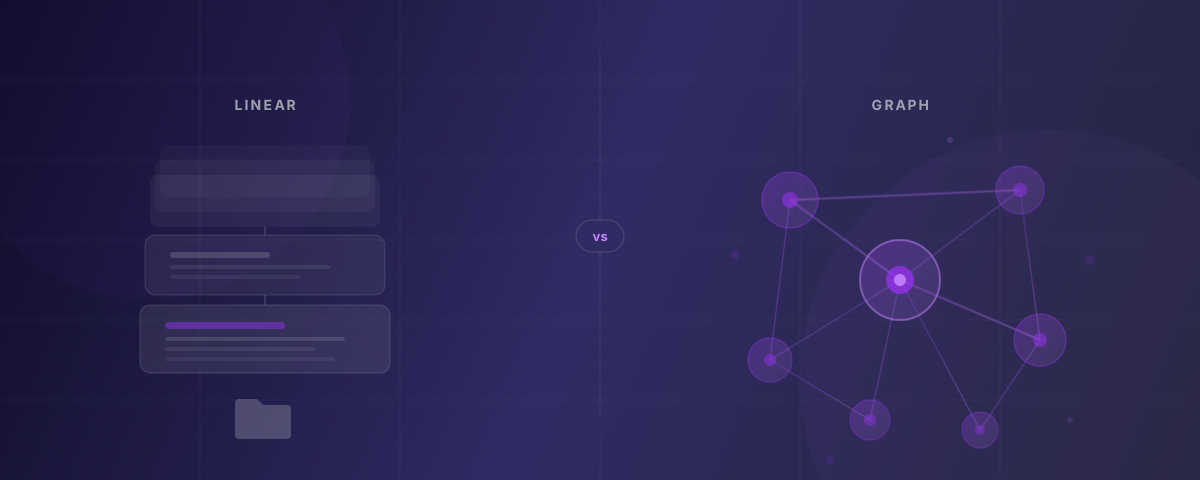
Linear note-taking is the default. Notes live inside documents, documents live inside folders, content flows top to bottom. It’s how books are written, how reports are structured, how most of us were taught to organise information.
That works well for a lot of things. Linear notes are easy to read, easy to share, and great for producing clean, polished output. When the structure is already known, linear systems are excellent.
The problem is what happens before you know the structure.
The hidden cost of linear systems
When you write in a linear document, you’re doing two things at once: thinking and organising. The format pressures you to make structural decisions before the ideas are fully formed.
Which section does this go in? Is this a heading or a bullet? Should this be a separate file? Does this belong before or after the other thing?
These aren’t small interruptions. They’re context switches. Each one pulls you out of exploration mode and into editing mode. For simple, well-defined topics this barely matters. For complex, open-ended thinking (research, planning, learning something new) it slows you down in ways that are hard to notice because the friction is invisible.
Linear systems assume you already know the shape of what you’re thinking. But the whole point of thinking is that you don’t yet.
What graph note-taking does differently
Graph note-taking removes the question of where something belongs and replaces it with a simpler one: what does this relate to?
Instead of nesting notes inside folders, you connect them to other notes. Each note becomes a node. Each connection becomes a relationship. Structure doesn’t precede the thinking. It emerges from it.
You write a note about a concept. You link it to another note where that concept came up. You write a third note and notice it connects to both. Over time, a map of your thinking builds itself. Clusters form. Patterns become visible. Ideas you captured months apart turn out to be related.
That’s something a folder hierarchy can never show you.
Where Graphora fits in
Graphora is built around the graph model, but it doesn’t force you to choose between exploration and structure. You can do both in the same tool.
Start in the daily journal. Capture a rough thought without worrying about where it lives. Link it to an existing note with note links if something connects. Let the graph build as you write.
When a topic gets clear enough to deserve a proper document, write it. Link back to the notes and journal entries that led you there. The messy thinking and the clean output live in the same workspace, connected.
That’s the workflow: unstructured exploration first, structured clarity when it’s ready. Not as a two-step process across different tools, but as a natural progression in one place.
Which approach is right for you
Neither system is universally better. They’re optimised for different stages of work.
Choose linear when:
- You’re writing a final report or document
- The structure is already clear and agreed on
- You need output that’s easy to read and share
- The topic is well-defined and unlikely to grow
Choose graph when:
- You’re researching or learning something new
- You’re brainstorming or working through a problem
- You’re building knowledge that compounds over months or years
- You want to find connections you didn’t know existed
Most knowledge work involves both stages. The research phase is exploratory: messy, non-linear, associative. The output phase is structured: clear, sequential, polished. The best tools support both without forcing you to switch between apps when you shift modes.
The question that actually matters
It’s not “which system is better?” It’s “when should structure enter the process?”
Too early, and you’re organising before you understand. Too late, and you’re sitting on a pile of disconnected notes that never become anything.
The goal is a system that lets you think freely first and organise when you’re ready. That’s when note-taking stops being storage and starts being a thinking tool.
Start with a journal entry. Link a few notes. See how your thinking connects. No setup, no credit card, free forever on the Core plan.